
A simple goal setting template is a useful instrument to boost your goal setting efforts. With The Institute for Strategy Execution, I developed several practical strategy implementation templates. (You can download all templates for free at the bottom of this page)
In this guide, I will explain how to use the goal setting template.
Goal setting template: the ultimate guide
You can read this guide about the goal setting template chronologically or jump to any chapter:
- Goal setting template: the highlights!
- Part 1: goal setting
- Part 2: the habits (strategy anchors)
Goal setting template: worksheet highlights
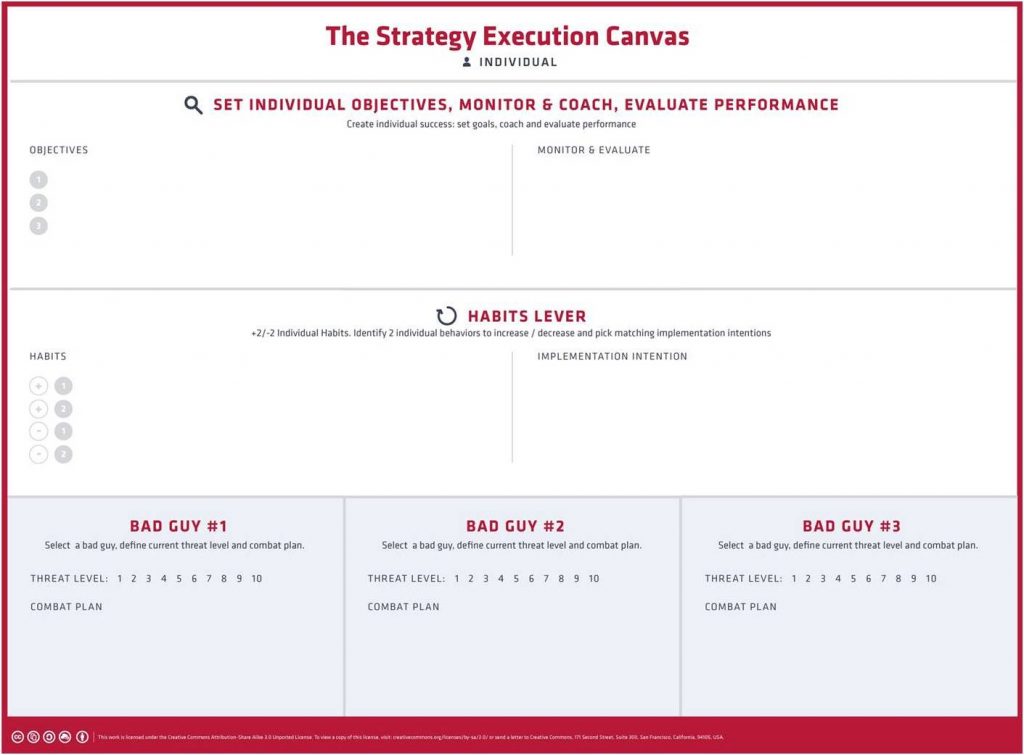
This goal setting template is basically a worksheet that covers 3 crucial areas.
(1) The goal setting part and follow up of goals
(2) The habits lever
(3) Change management
Goal setting template: #1. Goal setting
In 1990 Professor Edwin Locke and Gary Latham published A Theory of Goal-setting & Task Performance, a groundbreaking study based on 400 laboratory and field experiments carried out over 25 years.
Their research provides 2 important insights for our journey.
First, when we define goals, we perform better than when we don’t. Both professors argue that by setting goals, we create a standard for self-satisfaction with performance. In other words, by telling ourselves what success looks like, we want to chase it and be successful.
Secondly, regular feedback on our progress towards our chosen goal boosts our performance.
Read more: the ultimate guide to the Goal Setting Theory
Set smart goals
This is the first exercise from the goal setting template. Most companies have an annual, individual goal setting process, part of the classic strategy implementation process. So we are not reinventing the wheel, but connecting the strategy execution steps.
Your challenge:
Use the goal setting template and set great goals for yourself. Do the same for team members
Tips:
1. Don’t break the business strategy chain.
Setting smart personal goals isn’t an isolated exercise. In fact, it’s the final step in a series of events, all aimed at dividing the business strategy into smaller parts. The sum of your personal goals is your strategic action plan at the minutest level of detail.
In order to make it all add up, the relationship with the next level up is crucial. Without it, the organizational value is completely lost and could result in great-sounding objectives which don’t support your company strategy.
2. Make sure it all adds up
Imagine you are the manager of an IT department comprised of 30 people, of whom 8 are project managers, 19 project members, and 3 support staff. You discover, via an internal audit, that only 73 percent of your projects deliver results on time and within budget.
The main reason: poor project management. You ask HR to find a good project management skills course and, being a good performance management scholar, give all 8 project managers the following SMART goal: to take a 2-day project management course in the following 3 months.
How great are your chances of attaining a better score on your next project delivery audit?
Pretty low, wouldn’t you say?
And that’s not because the objective itself is wrong, but because other objectives are missing to complement this one. In other words, the lower-level objective of sending your 8 project managers on a 2-day course won’t be enough to achieve your overall goal of improving the project delivery on time and on budget.
Always ask yourself the following question: ‘Would I bet my own money on this combination of goals to reach the one above?’.
If the answer is no, you still have some work to do.
Here are 2 actions you might want to consider:
- What other goals can you add to increase the likelihood of success? Make a list. Rank all actions, starting with the one you think has the most impact on the realization of your overall goal
- Try to reformulate the existing objectives So to sum up, evaluate not only if an individual objective contributes to the overall goal, but also question if the contribution is large enough. If not, take action.
3. Don’t be too SMART
What does the ‘T’ stand for in SMART?
Is it ‘Time-based’ or was it…?
When I talk to managers, I often feel that goal setting has been downgraded to a ‘using the SMART goal setting technique’ drill. The essence has been lost.
The acronym is well-known but few understand the real dynamics of goal setting and the added value for the successful implementation of a strategy. Most managers are clueless and thousands of company money is spent on training to reinforce this ignorance.
So does this mean that the SMART model is ineffective in today’s working world? Not at all. It still has its advantages—it’s recognized by most managers and is a great aide memoire for goal setting. Just be careful it doesn’t become a goal in itself.
4. Don’t assume too quickly that someone is motivated
As you know, commitment is crucial to the success of individual objective setting. No commitment means no performance, whatever else you try.
So while most managers focus only on the objectives, you want to focus on the objectives and the other person in the room, obtaining that crucial commitment.
But be careful!
Peter Senge, author of the best-seller The Fifth Discipline, believes that “Ninety percent of the time, what passes for commitment is compliance”.
In other words, you might think you have that very important goal commitment in the bag, but in reality, you don’t. You only have something that resembled the real thing.
Here’s a specific guide if you want to work on personal goals and personal motivation.
5. Focus on getting the leadership objectives right.
Most people find it difficult to define high-quality leadership objectives.
In fact, almost all managers I know find it much easier to define ‘hard’ business objectives than ‘soft’ ones.
But instead of putting in the extra effort required to get them right, they take the easy way out and end up with leadership objectives such as ‘go to leadership training’, ‘organize more communication sessions’ or ‘work on your management skills’.
So what’s the magic trick to define those leadership objectives?
Here are just a few that will help you get the job done:
- Think and talk behavior.
- Describe and discuss suitable behavior—and equally or even more importantly, what doesn’t fit
- Compare behavior. Do you know somebody who has the right leadership behavior? Use them as an example in your discussion
- Keep it simple. Competency dictionaries and leadership models often provided are way too detailed and won’t serve your purpose.
- Don’t try too hard! Don’t overdo the measuring part. People with SMART training under their belts have been taught to make every objective measurable. But participants need a discussion and feedback, not a mathematical formula.
6. Don’t let a template ruin an important exercise
Ideally you shouldn’t need to worry about templates.
But since the world isn’t ideal, you might be faced with a highly complex and user-unfriendly, objective-setting document.
But don’t let a poor-quality document affect your professionalism.
Don’t allow your meeting to disintegrate into a ‘we have to fill in this template for corporate reasons’ exercise. This won’t do justice to either you or your colleagues. Keep the quality standards as high as possible.
Start with a blank sheet of paper if it helps. You can always transfer the results of your meeting onto the template later. And don’t forget to tell those in charge that the document isn’t fit for the job. If they are smart, they will get to work.
Goal setting template: #2. Habits (Strategy Anchors)
Repetitive weekly cues that help automate execution decisions are called ‘Strategy Anchors.’
They help us take on the villain Willpower Depletion during the time that habits remain unformed or fragile. These anchors ensure that our good intentions on the road to success aren’t blown away by day-to-day distractions, competing destinations, or existing bad habits.
You might have spotted that I suggest a weekly rhythm. It’s true that a daily rhythm creates habits faster—but in my experience, a daily schedule is unrealistic in most business environments.
A 7-day rhythm however gives you the benefit of regular repetitions, while following a more natural business flow. As the authors of the The 4 Disciplines of Execution nicely point out, “In many operating environments, weeks represent a natural rhythm or organizational life. We think in weeks. We talk in weeks. They have beginnings and ends. They are the staple of human condition and make for a perfect cadence of accountability.”
The Strategy Anchors don’t have to dominate the agenda.
But they have to be there, week after week, month after month.
There will be times when we face tempting distractions. There will be times, especially at the start, when they wonder if it’s all worth it. There will be times when travelers are swamped with work and don’t really have the time. But the user manual for strategy anchors is very simple.
If someone, for whatever reason, removes an anchor from their agenda, they need to re-attach it in that same week. Remove the anchor and the ship is lost. Strategy becomes like a shipwreck bobbing on the waves, destined to end up far from the finish line.
Luckily, after some time, the power of a habit kicks in and the Strategy Anchors grow stronger. And if you keep going, they’re so engrained that you respond automatically to the cue.
Habits are a force of nature. And we too can take advantage of their power on our strategy journey.
We just have to follow nature’s logic to create a habit.
And the logic is this: Strategy Anchors force repetition. Repetition creates routines. Routines beat Willpower Depletion. Hands take over from the head. And the activity, once experienced as extremely difficult, becomes second nature.
A habit is born.
Your challenge:
Identify 1-3 repetitive building blocks in your weekly schedule that will help you to build the identified habits.
Tip:
I like to put these building blocks in the morning when there’s no willpower drain Don’t be too ambitious. Agree for the whole group to use the same anchor. For example, every Wednesday morning from 9-10am, we do outbound calls to at least 10 potential clients
The third building block about change is covered in a separate guide.
Like this goal setting template?
Want to inspire others to improve their goal setting?
Share now!