

Megatrends impact your business strategy. Whether you know it or not. Whether you like it or not. Your company is part of a larger ecosystem, one that changes constantly.
Your role is to separate the noise from the important stuff and make smart choices based on the megatrends you observe.
There are thousands of trend watchers.
For each industry or product niche you will find several.
But for me, the key question is not so much about the megatrends itself.
It’s about the potential positive or negative impact these megatrends have on your business strategy, and what you should do (or not) with this knowledge.
Said differently: “Which megatrends are important for your business? “ and “What are you going to do with that knowledge?”
Frederic De Meyer is a former executive from Cisco and founder of the Institute for Future Insights. He’s a megatrends specialist and author of the book Megatrends.
I asked Frederic to share some of his thinking about megatrends with us and I’m happy he agreed to do so.
The hidden impact of megatrends on companies and industries
“After a business implements a strategy, competitors will react, and the firm’s strategy will need to adapt to meet the new challenges. There is no stopping point and no final battle. The competitive cycle continues on perpetually. Produce and compete or perish”
– Thomas Timings Holme
How certain are you that your business will still exist twenty years from now?
Maybe this question is not bothering you at all. After all, twenty years is a long time.
But if you do care, you might find out that it is very hard to provide an answer to this question. Ultimately, the answer depends on how well you anticipate and adapt to long-term shifts that might not even be visible, or that are visible but their exact direction and amplitude is not yet known. Very often you don’t seem to have any sort of influence on or control over these trends.
So how could you take them into account?
Ford and Barbie
If Ford would not have adapted to its clients’ demand for more customization, if it had stick to its founders’ vision of uniformity, it would have gone bankrupt a century ago.
Mattel’s Barbie lost its market dominance in a single year to brand new competitor Bratz, because it failed to see how new youngsters are maturing much earlier in life.
As these examples show, long-term shifts form short-term threats to companies who don’t recognize them and act on them. Luckily, they also form opportunities for those who do.
Trends impact companies AND industries
It’s not only companies that are affected by trends and megatrends. Complete industries can undergo very profound changes due to these shifts.
For instance, the emergence of a ‘global grid’ enabled new business models such as ‘peer-to-peer’ lending in the financial sector, ‘fan funding’ in the music industry, crowd sourcing and open innovation in the marketing sector.
For established companies in these industries, the capital question now is whether they should embrace these new business models, or stick to the old ones (with all the risks this entails).
Hard, but not impossible to integrate into strategic thinking
All these influences make it very hard for companies to reply to the original question: “How certain are you that your company will survive in twenty years from now?”
Companies often don’t have any influence over these trends, so it’s even harder to assess how they will impact their competitive advantage, and how to adapt one’s business strategy to it.
It is hard, but certainly not impossible.
Megatrends often offer unique ways to rethink a business and better prepare it for the long term.
The picture below provides a general overview of which corporate activities can benefit from the influence of megatrends:
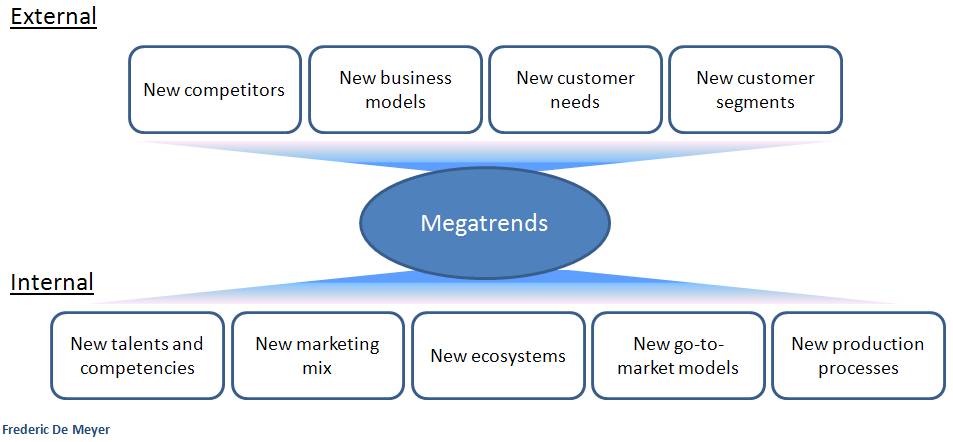
Of course, not all of the megatrends have an influence over all of these activities.
The exact nature and the importance of this impact will depend on the industry you serve; as well on the way you operate your business. But the picture above stresses the importance of having a thorough look at megatrends and assess how exactly they impact your business.
How companies benefit and suffer from megatrends: 4 examples
There are plenty of examples of how big and small companies are impacted by megatrends.
Let me just highlight those companies that have struck me most in four areas of using megatrends in corporate strategy:
Example 1. Companies that didn’t see megatrends coming, and suffered from it
Water shortage definitely became a major issue in the last decade, and will remain to do so in the coming ones. Those companies operating in an environment subject to drought need to have a very close look at their processes, or else share the fate of Coca-Cola India, whose products were boycotted several times between 2003-2006 because of (very) bad water management in their plant in South Indian state Kerala.
This story has a painful tail: Coca-Cola has since revamped their operations (worldwide) to take better care of the water usage –and received many sustainability awards for it-, but whenever you google ‘Coca-Cola India’ you’d find thousands of negative articles before finding something about their sustainability achievements.
The Internet has a long memory…
Example 2. Companies that discovered new opportunities by studying megatrends
The most obvious example here is Tata’s Nano car, the ‘cheapest car in the world’, specifically designed to serve the rising middle class in India. The idea is as simple as it is obvious: the income of millions of Indian households is rising to standards where they can afford some extra luxury goods, surely they’d want to buy a status item such as a car?
Well, not so quickly. The Nano car has not quite met expectations in terms of sales –there’s a significant amount of reasons for this, none of them is questioning the fact that there is a huge market potential for the car.
It shows us that finding new opportunities and executing on them are two different things.
Example 3. Companies that embrace new business models emerging from megatrends
Business model innovation is the biggest thing in business right now, to such an extent that some argue it is a trend in itself. Fair enough, but some new business models are a result of distinct megatrends as well.
And the most crucial question any business is facing with regard of this is: “Should I fight or embrace such new models?”
Take the ‘desintermediation’ trend as an example. With the ever increasing interconnection of people worldwide, many businesses that serve to connect supply and demand seem to become obsolete. Even the banking business is not safe –why not create platforms to connect people with too much money with people who are in need of it?
Welcome to ‘peer-to-peer’ lending. While relatively small and prone to some growth pains, the business is growing some 400% yearly. Should banks combat this, or should they embrace it? ABN Amro seems to have made the very first –although very careful- step in this direction.
Example 4. Companies who have made megatrends the center piece of their business strategy
The single best example in this space is Siemens. Just type ‘Siemens megatrends’ on Youtube and in 7 minutes you will see exactly what I mean. What Siemens did was to (re)align each of its business unit with a specific megatrend (urbanization, ageing society, climate change, …).
This offered a very compelling message to all its stakeholders (‘Siemens is working on resolving big issues’), but, more importantly, in terms of strategy execution it tremendously helped them to sell the new business strategy to its employees, hence ensuring a smooth transition to the new structure.
“As for the future, your task is not to foresee it, but to enable it” –Saint-Exupéry
How to integrate megatrends in your strategic thinking
How can a strategist use megatrends?
There are plenty of ways you can study megatrends and draw conclusions for your company’s future strategic direction. However, there is no miracle way. I have been running this exercise for 3 years at my former employer Cisco and ended up making the distinction of 6 crucial steps in the megatrends process:
- Make a selection of megatrends to use for your business strategy exercise
- Discuss the selected megatrends in ‘think tanks’ including internal (and perhaps external) people
- Summarize and draw conclusions from the discussions
- Present to executives and make decisions
- Extensive communication internally and externally
- Measure progress with the right KPI’s in a Balanced Scorecard and repeat the business strategy process if needed
This looks simple enough. But, as always, the devil is in the detail.
So here are a couple of tricks to make this megatrends exercise a centerpiece for a successful business strategy exercise:
- When selecting megatrends to assess don’t be limited to these trends with an obvious impact on your industry. Think broad!
- Organize ’think tanks’ to discuss the impact of megatrends on your company
- Invite 4-6 people
- Make sure to include people with different backgrounds and levels of seniority
- For the discussions, schedule about 30-45 minutes per megatrend
- Structure the discussions, but you don’t necessarily have to stick to the structure
- Send a simple but thought-provoking briefing document to the participants (one fact sheet per megatrend)
- Use the conclusions of the discussions to communicate to various stakeholders
- Have fun! Obviously this is a serious exercise, but from my own experience I learned that people are very grateful to be asked to discuss the ‘bigger picture’ of your company
Like this article about megatrends?
Want to inspire others?
Share now!